
-
 Galvanized vs Bare vs Epoxy-Coated Bolts: Choosing by Design Life
- 14th octubre 2026
 Galvanized vs Bare vs Epoxy-Coated Bolts: Choosing by Design Life
1. Why Design Life Matters for Rock Bolt Selection
The design life of a rock bolt/ground anchor is how long the reinforcement system is expected to perform its design function.
Design life should not be related to coating appearance or guaranteed life span.
Every project will have varying levels of support life requirements.
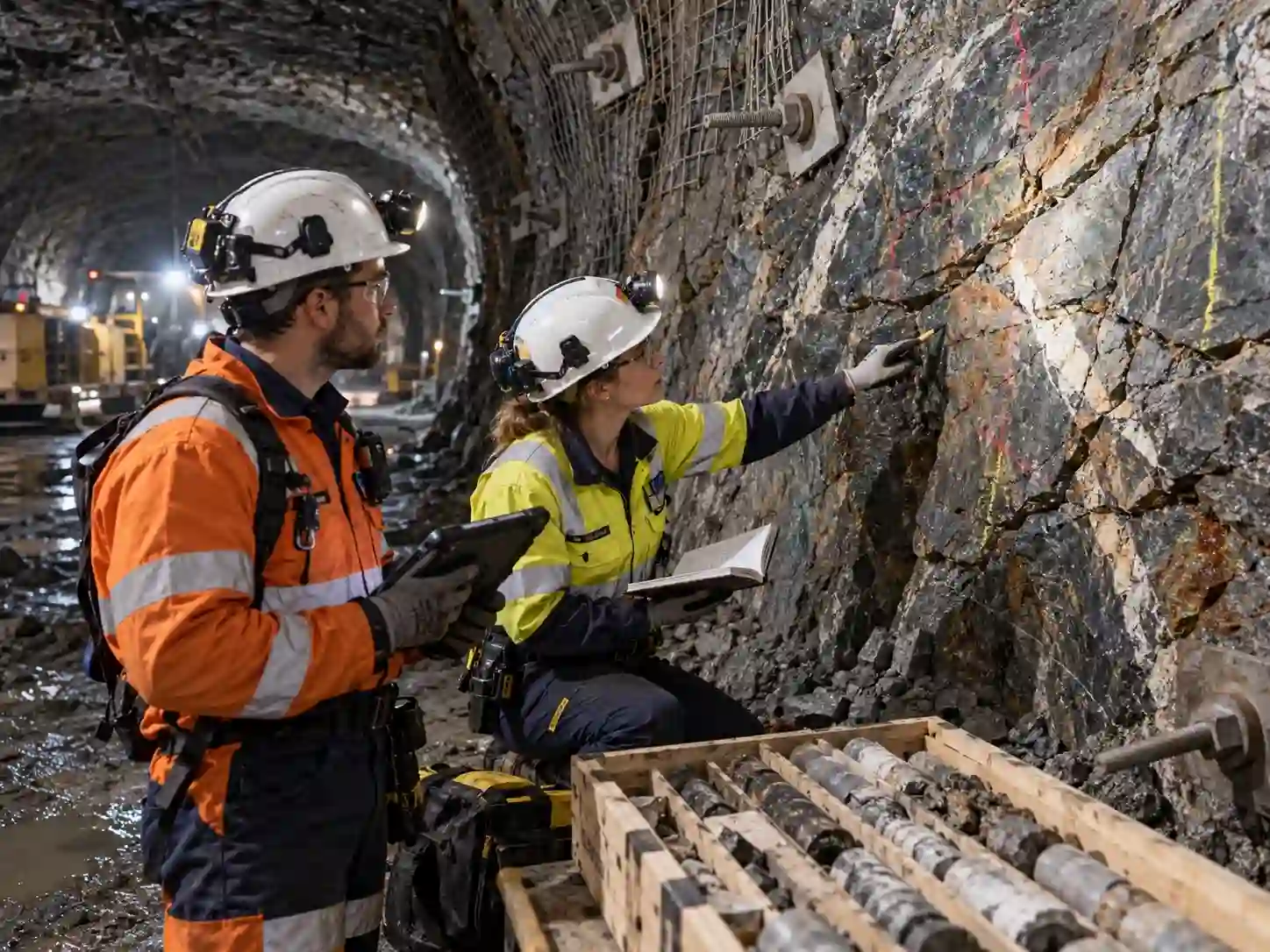
Mining Openings With Temporary Life Span
There are some excavations that you only need supported for a certain time frame.
If you know what your environment will be exposed to and your design allows for it you can use different methods of corrosion protection.
Just because something is temporary doesn’t mean there is no corrosion.
Ground water, higher temp’s and many other factors can affect your steel.
Mineral That Will Have A Longer Life Span
Road ways that go through a mine can last for many years. You may want to look into the following:
- Long term exposure to ground water.
- Corrosion of the steel and losing section.
- Will you have access to inspect?
- How difficult is it to replace?
- What will your remaining strength be?
- Will your entire system still work as intended?
Tunnels & Civil Ground Anchor
There may be other types of corrosion protection used on permanent structures. Some examples would be: Grouting with cementious materials.
Using casing or sheath, encasement or seal the head of the anchor.
FHWA has more information about corrosion protection for ground anchors. They state that corrosion protection must remain intact for the design life of the anchored structure.
To learn more about Reinforcement Systems check out our article Rock Bolt Types: Which Rock Bolt Is Right for Mining and Tunneling?
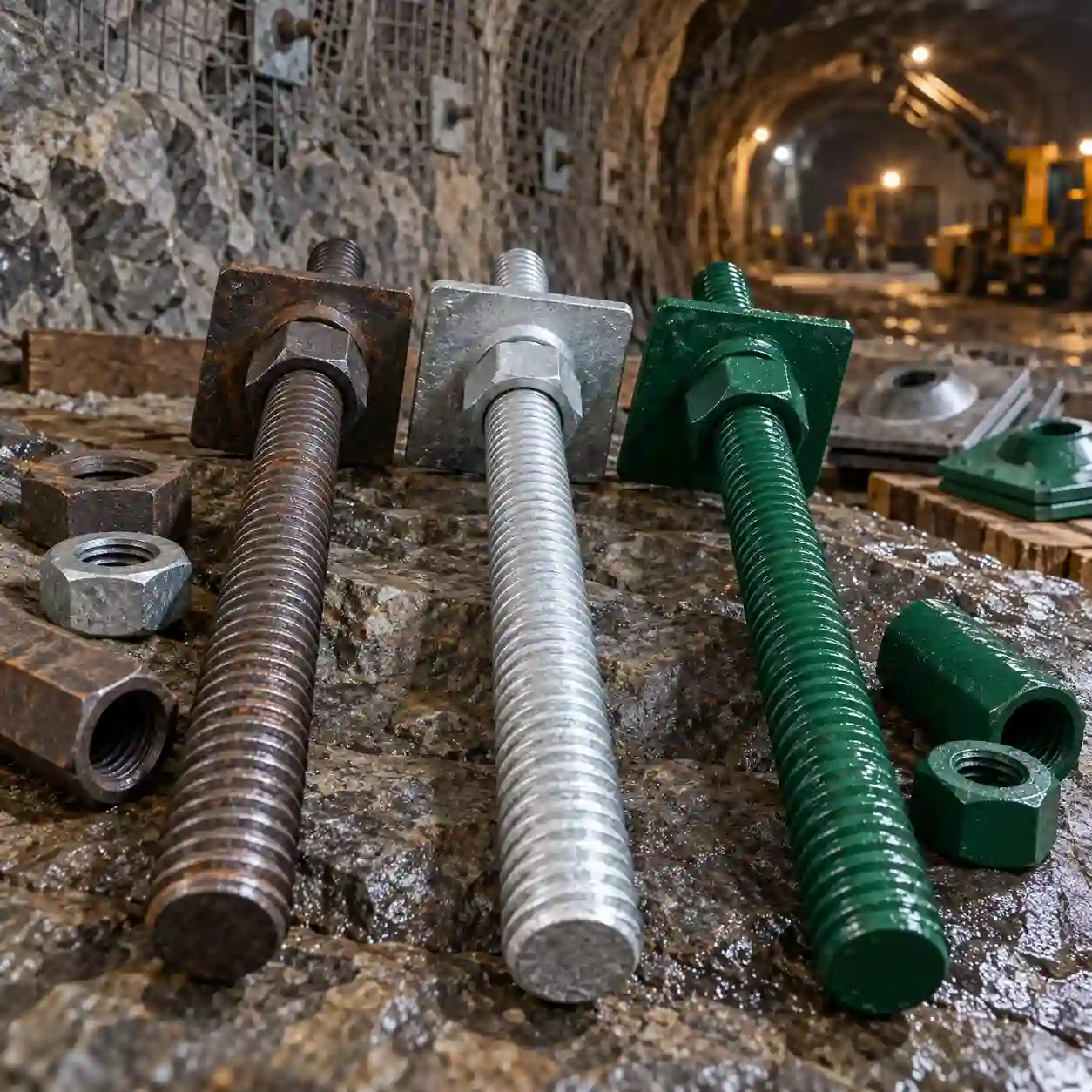
2. What Are Bare Steel Rock Bolts?
Bare steel rock bolts are a type of reinforcement that has no metallic or polymer coating purposely applied to it.
Threaded rebar rock bolts, all threaded bars and some other forms of rock reinforcement manufactured from carbon steel.
Can be resin or cement grouted, mechanically anchored or as per specified method of anchorage.
This does not always mean the rock bolt will be in direct contact with ground water over its full length.
As there could be some benefit gained from a grouted installation if done correctly.
However you need to take into consideration the grout medium, crack, voids and any exposed threads and anchorage head.
Benefits of Bare Steel Rock Bolts
Cost Effective
By using bare steel we can remove some manufacturing processes that are required when applying a metal or polymer coating.
Compatible with existing anchoring methods
As we have no coating we can use many existing anchoring methods with resin and cement grouted applications.
Easy to inspect diameter
We can easily see what diameter of steel we are working with and inspect the thread profile and any visible defects from manufacturing.
Disadvantages
If left in the correct combination of water, oxygen and corrosive environments bare carbon steel will begin to corrode.
Some of these effects can be:
- Reduced diameter of usable steel
- Pin Holes and Corrosion
- Worn threads
- Reduce load capacity
- Damage to connecting hardware
When to Use Bare Steel
If your application has a short design life or can be justified.
- You know what corrosive environments you are in.
- Your anchorage system will suit.
- Effects from corrosion will be acceptable in your design.
- You have inspection or replacement procedures in place.
Just because it’s cheaper doesn’t always mean it should be used.
3. What Are Hot-Dip Galvanized Rock Bolts?
Hot dip galvanizing is where steel is coated with Zinc or an alloy of Zinc and Iron. By submerging the steel into a bath of molten Zinc.
There are two forms of corrosion protection offered when using a galvanized coating.
Barrier Protection
The coating will prevent the environment from coming into contact with the base steel.
Sacrificial Protection
Under the right conditions Zinc will also offer a form of sacrificial protection to the steel. This includes at some points of discontinuity within the coating.
This is why galvanizing is not only a barrier form of coating.
Why use galvanized rock bolts?
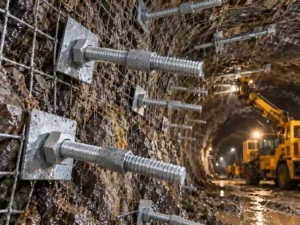
- Better corrosion protection then steel in most cases
- Offer sacrificial protection due to the Zinc
- Can allow for a longer period of time exposed to an environment
- Known industrial coating and methods for inspecting the coating
- Can be used on Steel Reinforcement
How long will my galvanized bolt last?
This is hard to say as it will depend on your environment and coating.
Some factors to consider when looking at life expectancy of a galvanized product.
- Thickness of the Zinc Coating
- Water Chemistry in ground
- Moisture and Oxygen levels
- Temperature
- Amount of Chlorides and Sulphates
- Localised Aggressive Conditions
- Damage to the Coating
- Threads/Connections
Although you may have a greater reserve of Zinc by increasing the coating thickness. It may not guarantee you a life span in all underground conditions.
Standard to Note
ISO 1461: 2022 gives requirements and testing for hot dip galvanized coatings on fabricated steel articles.
Some items such as Fasteners may fall under there own standards.
Always make sure you know what standard your rock bolt/nut/plate etc will be galvanised too.
When installing make sure that your galvanised reinforcement is compatible with:
- Nuts/Couplers
- Bearings
- Head Plates
- Resin or Cement
- Diámetro del orificio
- Anchorage Requirements
If the thickness or process changes on the galvanized item this may not always be suitable for all anchorage systems.
For mining applications, see Wanfeng’s Soluciones para el refuerzo de galerías mineras.
4. What Are Epoxy-Coated Rock Bolts?
Rock bolts that are coated with epoxy have a layer of organic polymer on the outside to help shield the steel from its environment.
Can be achieved using various industrial coating methods, some which may fall under the category of a powder coating.
Epoxy coating will not act similar to a hot dip galvanized coating. There is no zinc coating to protect the steel.
Only if the protective layer is able to stay continuous and bonded to the steel will it be effective.
Benefits
Can provide barrier protection from the environment
By specifying the right coating it can limit the exposure of the steel.
Coating options
Can specify different types of coatings depending on your application (once qualified).
May be applicable to your corrosive environment
Steel with an epoxy coating can be used if you know the coating can withstand your environment.
Downsides
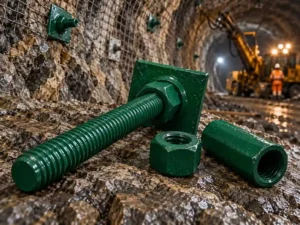
Epoxy can be scratched/chipped off by;
- Transportation
- Perforar
- Instalación
- Rocks
- Bolting threaded parts together
- Impact/dents
If there are any holes/scratches/breaks in the coating or it doesn’t adhere properly to the steel it will not be as effective at protecting the steel.
There is no sacrificial coating to help protect the steel like with a zinc coating.
Something to consider when using rock anchors
If you are using fully grouted rock bolts the coating could change how the rock bolt is anchored.
Depending on what changes it makes to the rock bolt it could have an effect on your anchorage.
You should not just swap out your uncoated rock bolt with an epoxy coated one.
It may need to be tested/qualified by the manufacturer for your specific anchoring system.
For additional context on long-term anchor performance, see Wanfeng’s Soluciones de anclaje para muros de contención.
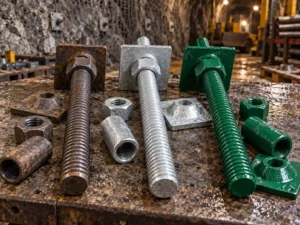
5. Galvanized vs Bare vs Epoxy-Coated Bolts: Comparison
| Factor | Bare Steel | Hot-Dip Galvanized | Epoxy-Coated |
|---|---|---|---|
| Protección contra la corrosión | No dedicated coating | Zinc-based barrier and sacrificial protection | Polymer barrier |
| Initial material cost | Generally lower | Additional galvanizing cost | Additional coating cost |
| Coating damage | Not applicable | Damage reduces local zinc protection | Damage can expose underlying steel |
| Protection at small defects | Depends on environment and other protection | Zinc may provide sacrificial protection | No inherent sacrificial protection |
| Coating thickness control | Not applicable | Requerido | Requerido |
| Grout compatibility | Must be verified | Must be verified | Must be verified |
| Thread compatibility | Depends on geometry | Coating allowances may be necessary | Coating protection and fit must be considered |
| Installation concerns | Corrosion exposure | Coating damage and assembly fit | Scratches, pinholes, and adhesion |
| Long-term suitability | Project-dependent | Project-dependent | Project-dependent |
| Main selection criterion | Acceptable corrosion risk | Verified zinc protection | Verified barrier performance |
The following table is meant to show the qualities of each coating. It should not be used as a guide to service life.
Hot dip galvanized or epoxy coated steel products are not always enough to meet the corrosion protection requirements for a permanent ground anchor.
6. How Does Required Design Life Affect Coating Selection?
Often times projects will specify a certain coating based on a time period.
Temporary, Medium and Permanent life are good guidelines but will not always dictate what coating you need.
If you are requiring support for a shorter amount of time you may be able to use bare steel.
Depending on the applications and your design you may need to look into additional corrosion protection.
Even if you only have an excavation for a short time you may need to look into corrosion protection if you have high groundwater chemistry or the failure of your bolts could cause damage.
When requiring a medium or long term life.
You can start looking into Hot dip galvanized or Epoxy coated steel that meets the requirements.
There are many factors that you should consider when picking what product to use for your application.
Permanent Ground Anchor
When designing permanent anchors you will want to take corrosion into account. There may be more to it than just using a surface coating.
You may need to incorporate the following.
- Tendons with full encapsulation
- Grout using cementitious
- Covering your anchor with something
- Anchor head that can prevent corrosion
- Using corrosion inhibitors
- Drenaje
- Multiple types of corrosion protection
El FHWA Ground Anchors and Anchored Systems technical manual provides useful guidance on the principles of ground-anchor corrosion protection.
A Practical Design-Life Matrix
| Project Condition | Bare Steel | Galvanizado | Epoxy-Coated |
|---|---|---|---|
| Temporary, characterized low-corrosivity exposure | May be considered | May be considered | May be considered |
| Long-term, intermittent groundwater exposure | Requires corrosion assessment | Potential option | Potential option |
| Aggressive groundwater | Requires strong justification | Needs site-specific verification | Needs site-specific verification |
| Permanent structural anchoring | Coating alone is not the decision criterion | Often part of a wider design | Often part of a wider design |
| High-consequence or difficult-to-replace anchors | Enhanced protection assessment needed | Verify complete protection system | Verify complete protection system |
These are only considerations that need to be taken into account when screening a coating.
There is no amount of time we can say will occur with a coating based on information not known about the exposure and protection of that coating.
7. Underground Conditions That Influence Bolt Corrosion
7.1 Ground Water
Ground water may have an effect on the steel and coatings.
Some properties of ground water to take into consideration:
- pH
- Chlorides
- Sulphates
- Oxygen content
- Conductivity
- Temperature
Depends on the environment you are working in.
7.2 Wet/Dry
Bolts can experience a wet/dry cycle which may affect corrosion rates on exposed bolt heads and plate or threads.
7.3 Grout
Proper cementitious grout can help create a beneficial environment for bolts.
But if there are air voids or cracks in the grout or lack of grout. Also if the ground water is very corrosive it can affect your coating.
7.4 Threads/Anchor Head
When designing a bolt for corrosion resistance make sure that the threads and anchor head are also considered. They will always be exposed.
7.5 Damage to Coating During Installation
Coatings that have performed well in accelerated weathering may not give you what you expect when installed. If damage occurs to your coating while transporting. Storing. Driving the bolt into the concrete. Tightening couplers. Installing plates or tensioning the bolt.
Make sure you keep this in mind if using a coating as your main defense against corrosion.
8. Why Coating Thickness Alone Does Not Determine Service Life
You could argue that Zinc thickness or Epoxy coating thickness is a valid comparison.
But it’s just one aspect of how a bolt will perform.
A Galvanised bolt will have its Zinc layer eaten away over time. This depends on what environment it is in.
Epoxy coatings need to be continuous and bond to the bolt. As well as being chemically resistant. The application method and if it’s damaged during install also play a part.
What should you look at when choosing a bolt:
- Spec that the coating complies with.
- Grade of steel and shape of bolt.
- Thickness of coating and coverage.
- How the surface was prepared.
- Bonding and coverage.
- If it can come into contact with the product it’s anchoring in to.
- If it can be damaged during install.
- What life you want from the bolt.
Will salt spray testing help?
Yes it can give you some comparison values in certain scenarios.
But this doesn’t tell you how long your bolt will last once in the ground with water.
Same goes for testing to show you coating thickness. You can’t assume that the anchor has a certain amount of life left based on this.
When specifying coating thickness for paints there are some helpful documents called ISO 12944. These will outline what type of paint you should use for steel in different situations.
Again make sure you check if these apply to your situation when looking at using them to spec underground rock anchors.
9. Does Coating Affect Rock Bolt Load Capacity?
The coating will most likely not eliminate the need to ensure mechanical properties are achieved on the steel.
The rock bolt system will need to be able to achieve the required:
- Yield load
- Ultimate load
- Alargamiento
- Threads
- Capacidad de anclaje
- Capacity at the connection point
- Deformations
There may be some additional considerations when it comes to manufacturing or the coating itself.
Threads
The thickness of a coating can have an effect on threads and fitting of hardware.
Ensure all nut/coupler/hardware components are able to fit onto the bolt with the coating applied.
Resin Anchored
Load transfer will need to be established with the coated bolt and resin used.
Cement Grouted
When using cement grout as your anchoring material. The steel or coated steel will interact with the grout and rock. You will need to establish the load transfer ability of these materials.
High Strength Steels
If using a higher strength steel or special steel. Check if any metallurgical effects or embrittlement can occur when coating or surface treating.
Do not allow any coating process to be used just because it looks good.
Mining Ground Support Systems Explained: Bolts, Cables, Mesh and Straps
10. Can Galvanizing and Epoxy Coating Be Combined?
Yes there can be multiple coats on a steel protection system.
A zinc coating can be used with an organic coating for extra corrosion protection. This would have to be detailed on the design/process.
Duplex coatings or dual coated coatings are commonly used. There are many different types of duplex coatings and processes.
ASTM A1055/A1055M is used to specify zinc alloy/epoxy dual coated rebar.
This would need to be verified if it’s used on rock bolts and some anchor systems.
It may need to be verified that a dual coat meets:
- Order of coating
- Preparación de la superficie
- Coating to coating adhesion
- Thickness of total coating
- Threads
- Ability to bond to grout
- Not damaged during install
- Follow product specification
Just because there are more coats doesn’t mean your installed anchor will perform better.
11. Which Coating Is More Cost-Effective?
While initial cost is a consideration when making your choice of product.
Comparing products using lifecycle cost can give you a better idea.
Initial Material Cost + Coating + Installation + Inspection + Maintenance + Repair or Replace.
Costs associated with indirect costs in an underground environment could also include.
- Loss of production
- Restricted access
- Rehabilitation
- Equipment down time
- Extra ground control
There may be situations where using a bare steel bolt will prove to be more cost effective.
If you are able to reduce your identified corrosion issue then using a coated product may prove to be beneficial over its life cycle.
You may need to consider a more extensive life cycle product when using in permanent or inaccessible areas.
The above is only a general guide you must evaluate what will be cost effective on your application.
12. Procurement Checklist for Corrosion-Protected Rock Bolts
When asking for quotes from Mining Contractors you should know what your basic requirements are before hand.
What rock bolt are you looking for?
- Type of rock bolt
- Overall Length & Diameter
- Grado de acero
- Yield Strength and UTS
- Threads size and type
- How do you want it anchored
- Size and type of bearing plate and nuts
What corrosion protection do you require?
- Design life of bolt
- Environment
- Ground Water
- Bare Galvanised Epoxy Coated or System
- Coating Standard
- Espesor
- How will you inspect the coating
- Repair of damaged coating
What system will it be used in?
- Resin / Cement
- Tamaño del agujero
- Compatible couplers
- Install method
- Testing mechanical
- Testing anchorages
- Inspections and Maintenance
Documentation you may need from suppliers
- Certificados
- Test results
- Coating Inspection
- Espesor del recubrimiento
- Declaration to Standards
- Drawings
- Packing / Handling
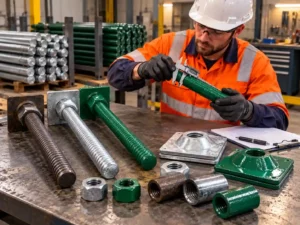
If your after something specific check out our Product Supply and Systems page here at Wanfeng.
13. Common Mistakes When Choosing Coated Rock Bolts
Mistake #1: Thinking if its galvanized its not going to corrode.
There are many factors that can affect the life of your zinc coating.
Depends on coating properties and environment it is placed in.
Mistake #2: Epoxy will always outlast galvanizing
They both offer different methods of corrosion protection.
No coating has a longer service life over another in every situation.
Mistake #3: Using one method of protection on all parts.
Bolts body nut plate coupler and exposed anchor head could be subject to different exposures or forms of abuse.
Mistake #4: Damage from Installation
Damaged coating due to scratches threads damaged etc can shorten the life of your protection.
Mistake #5: Using the coating as the entire permanent anchor system.
You may require additional grouting sheathing encasement sealed anchor heads etc.
Mistake #6: Choosing by Cost.
Just because something costs less may not give you the best value over its life cycle or meet engineering requirements.
14. FAQ
Q1: Should I use galvanized rock bolts over plain steel bolts?
In many situations yes, they will offer more corrosion resistance than plain steel bolts. As mentioned above there are many variables to consider when selecting your bolt type.
Q2: How long will my galvanized rock bolts last underground?
This will depend on many factors such as zinc coating thickness. The quality and temp of ground water will also affect your service life.
Q3: Can I use epoxy coated rock bolts in a permanent tunnel?
Epoxy coated bolts can be used as part of a corrosion resistant system. If you are using a permanent anchor you may need more protection.
Q4: Will an epoxy coating affect my anchor’s ability to bond to the resin?
Yes it can have an effect on your bonds ability to transfer loads to the resin. Always check with your bolt and resin manufacturer.
Q5: Can I grout my galvanized rock bolts?
Yes you can use galvanized rebar as part of your grouted system if required.
Q6: Can I use plain steel bolts in my mine?
Again this depends on the application. If your bolts are only meant to be installed for a short time plain steel may be ok. These bolts can rust quite quickly if exposed to the elements.
Q7: Is hot dip galvanizing superior to epoxy coating?
Hot dip galvanizing provides an extra layer of zinc that can protect the steel. Epoxy provides a barrier to prevent corrosion from occurring. You should choose what best fits your situation and reinforcement package.
Q8: Do all parts of a rock bolt need to be coated?
All parts of a rock bolt should be corrosion protected. But they do not all have to have the same type of coating. It will depend on what is specified in your design.
15. Conclusion: Choose Corrosion Protection by Design Life, Not Appearance
You should determine what type of rock bolt to use based on your design life and what you will be exposing them to.
You can use bare steel rock bolts if you know what your application will require. You can also hot dip galvanized which will give you zinc protection or epoxy coated which will give you a polymer coating.
If your underground support is going to be long term or have higher importance you may need to look into more corrosion protection.
Always remember what works best is the corrosion protection that will allow the reinforcement to last its desired time for your project.
Rock Bolts and Corrosion Protection Options | Wanfeng
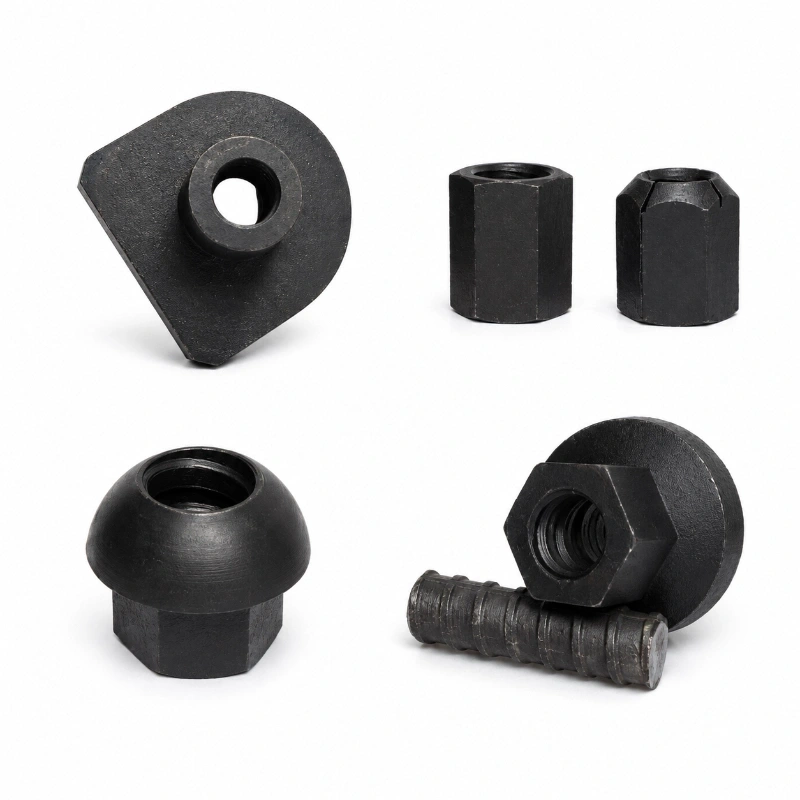
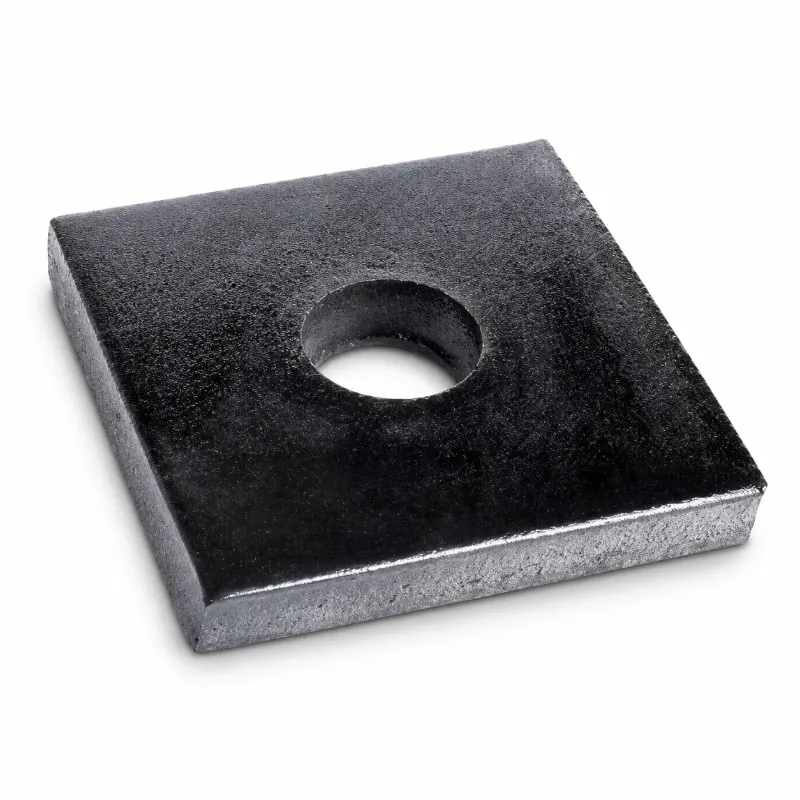
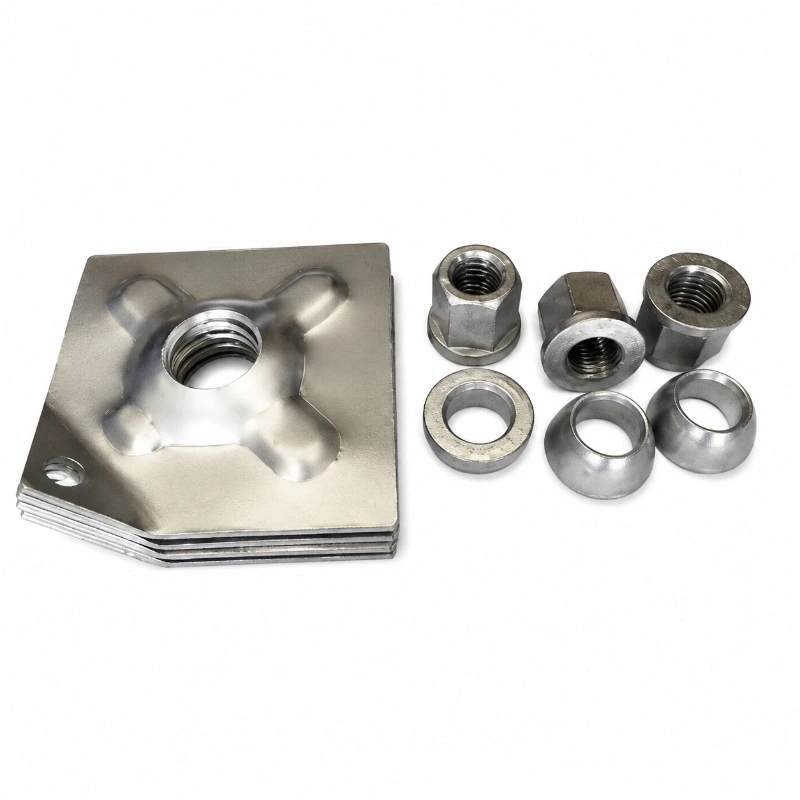
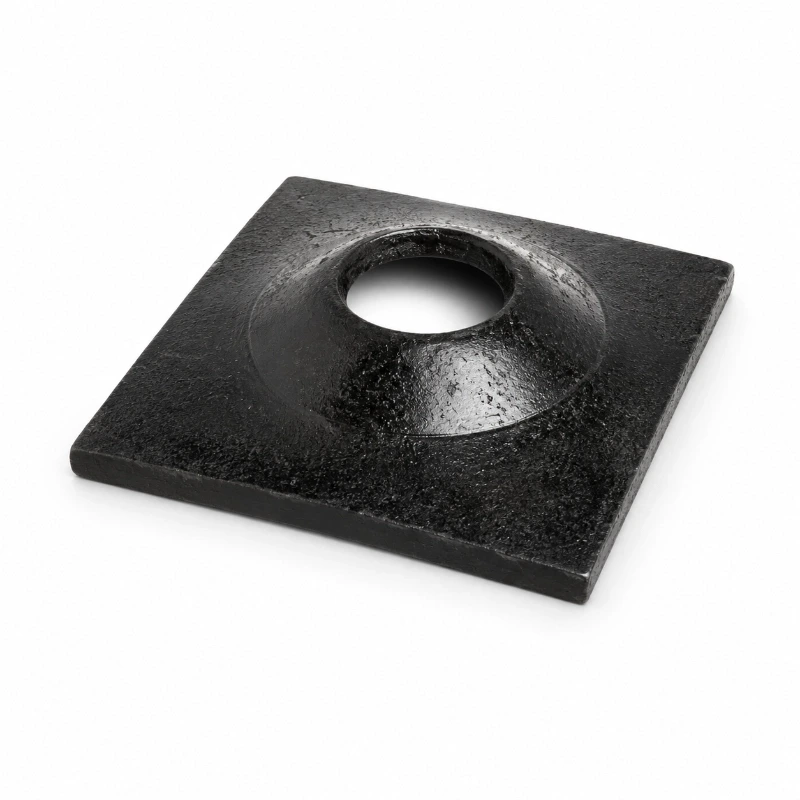
Wanfeng manufactures rock bolts and other mine/tunnel support products such as Threaded bar rock bolts, Rebar, Self drilling anchors, Bearing Plates, Nuts & Couplers and other accessories.
If you are looking for a project we can quote you off your drawings with desired steel grade, requirements and type of support you would like to use.
View Our Mining Support Products and Engineering Service or Rock Bolt Solutions For MINE ROADWAY
Contact us today for your quote. Include Rock bolt type, diameter, length, steel grade, coating, standard you want it to meet and quantity and drawing.
 Relacionado




Excelente servicio en todas y cada una de las ocasiones.