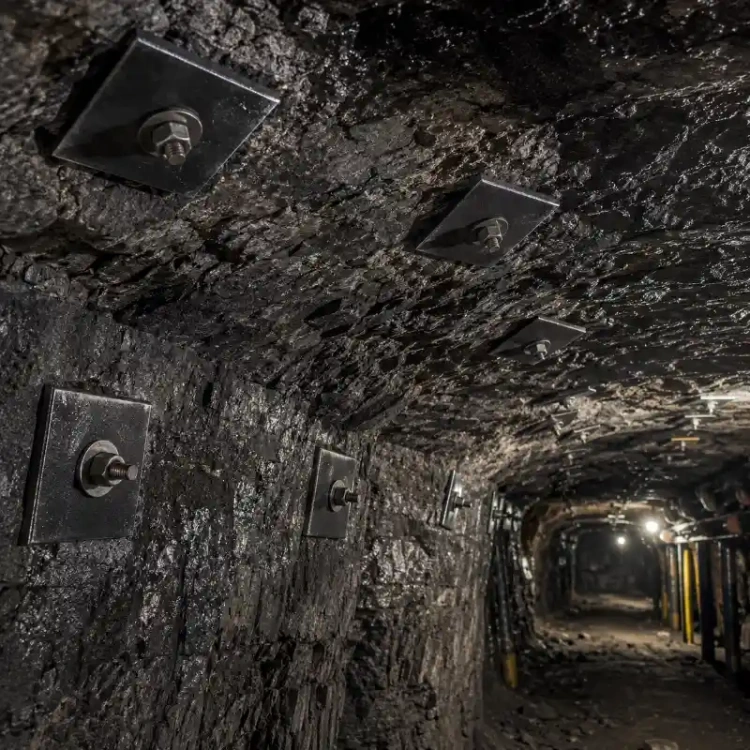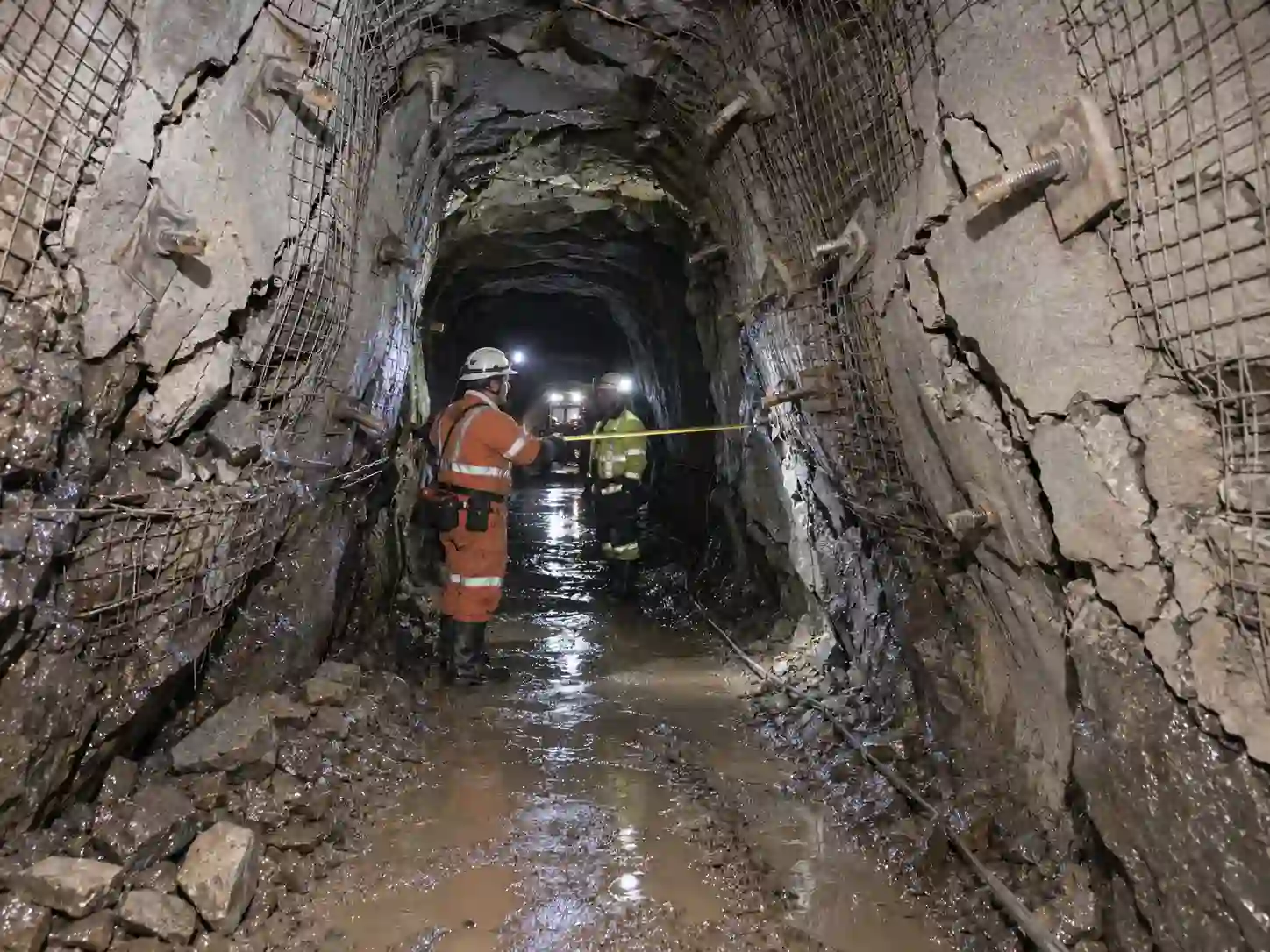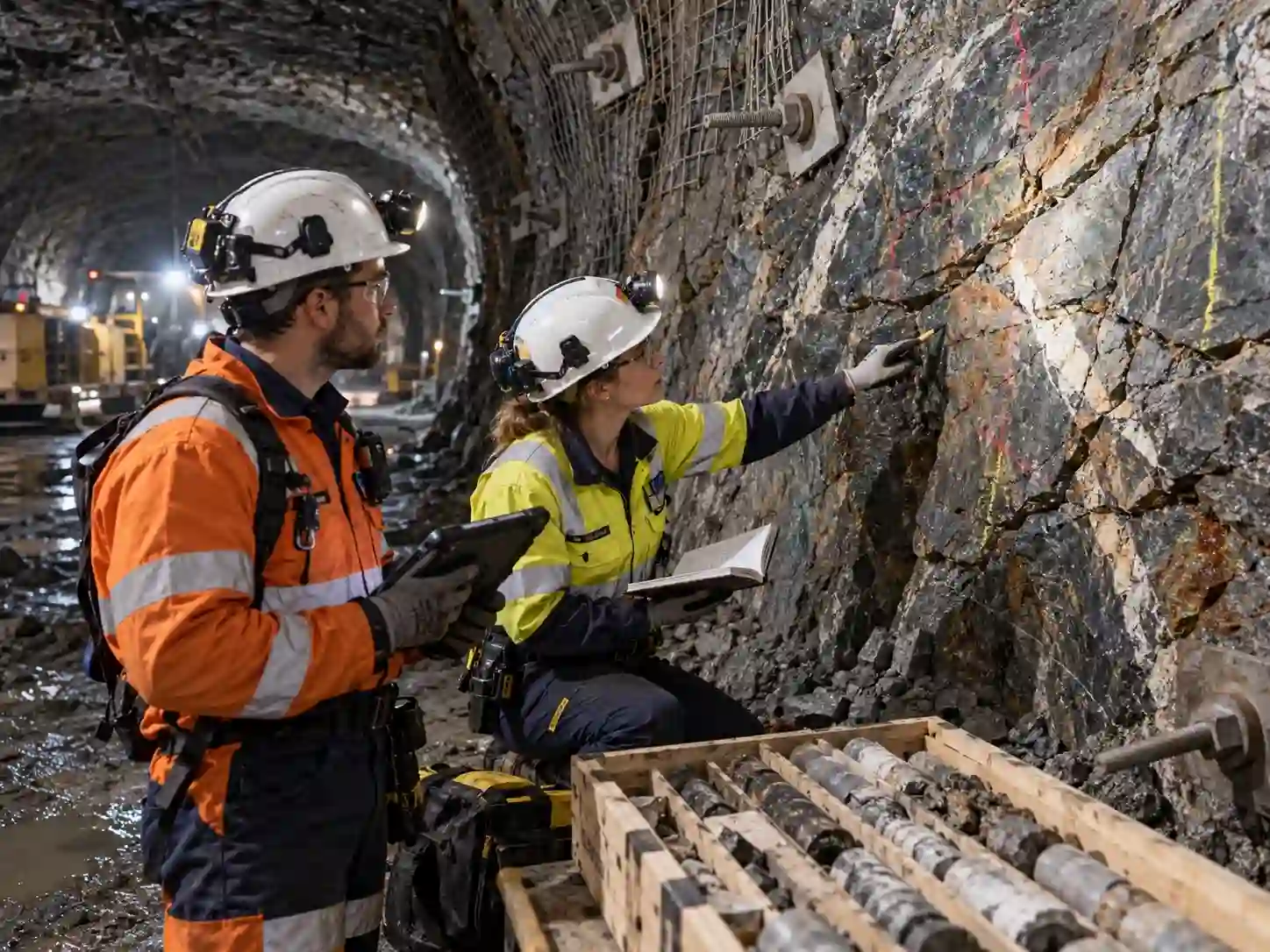


Both are used in mines and tunnels to help carry load into the surrounding rock mass. However there are some differences on how each achieves this.
Resin grouted rebar bolt will achieve anchor by the use of resin along the selected anchor length.
The mechanical expansion shell will gain most of its anchorage at one point at the rear of the borehole.
In short you could say:
Resin grouted rebar bolt gains anchor over it's length
Mechanical expansion shell is a mechanical anchor at one point.
There are many considerations when deciding what type of bolt to install in your operation.
Learn more about our range of Rock Bolt types here.

Split Set and Swellex are both used as friction-based rock reinforcement in underground mining and tunneling, but they do not work in the same way.
A Split Set-type friction stabilizer is a longitudinally slotted steel tube that is driven into an undersized borehole. The tube is compressed as it enters the hole, creating radial pressure and friction against the rock along the installed length. Official Split Set guidance emphasizes that anchorage depends strongly on the relationship between stabilizer diameter, borehole diameter and the actual ground condition.
A Swellex bolt is a folded, sealed steel tube inserted into the borehole and then expanded using high-pressure water. After expansion, the tube conforms against the borehole wall and develops contact with the surrounding rock. Epiroc currently publishes minimum breaking loads of 120, 120, 160 and 240 kN for the Pm12, Mn12, Pm16 and Pm24 Swellex models respectively.
So the simplest distinction is:
Split Set = drive the tube into an undersized hole
Swellex = insert first, then hydraulically expand the tube
Both rely on contact with the borehole wall, but their installation process, load behavior and sensitivity to site conditions are different.
For a broader overview of friction bolts within underground support systems, see Wanfeng's guide to Mining Ground Support Systems

Collapsing boreholes slowing drilling? See how self-drilling anchors combine drilling, grouting, and reinforcement to reduce rework.
Đọc thêm
Mining ground support is more than just bolting up with the strongest rock bolt you can find.
Excavating underground creates new stress conditions that didn’t exist before the rock was removed. The rock mass surrounding that excavation may respond by fracturing, loosening, deforming or moving towards the opening - depending on geology, depth, excavation geometry and mining method.
A ground support system is therefore designed to control how that rock mass behaves and to keep the excavation serviceable for as long as it needs to be.
Rock reinforcement inside the rock mass + surface support at the excavation boundary + connection of those elements to allow them to work together
Typically underground ground support will involve a combination of elements such as:
Underground excavations
The Australian Centre for Geomechanics states that reinforcement elements work by penetrating into the rock mass to restrain internal movement while surface support such as mesh, straps and shotcrete serve to retain loose material at the excavation surface. It’s the interaction between these components that make a ground support system effective, rather than the capacity of any single bolt.
Wanfeng's ground- support product portfolio takes a similar system approach, including rock-bolt systems, cable bolts, mesh, steel supports, support plates, fastening components and resin/cement anchoring materials.

Khi lắp đặt các cấu kiện gia cố cho các dự án khai thác mỏ, đường hầm và địa kỹ thuật, vật liệu neo đóng vai trò là chất trung gian giữa cốt thép và khối đá.
Bu lông neo đá không bao giờ hoạt động đơn độc.
Hệ thống neo đá = Neo đá + Vật liệu neo + Tấm đỡ + Đai ốc + Khối đá xung quanh
Hai trong số các kiểu neo phổ biến nhất là:
Neo nhựa
Vữa xi măng
Cả hai đều có thể là những hình thức gia cố rất hiệu quả nếu được thiết kế và lắp đặt đúng cách.
Chúng có những đặc điểm khác nhau về:
tốc độ cài đặt;
Khả năng truyền tải tải trọng;
thiết bị;
chi phí nguyên vật liệu;
Địa chất;
Hiệu quả củng cố lâu dài.
Không phải lúc nào cái này cũng tốt hơn cái kia. Tất cả phụ thuộc vào điều kiện của dự án.
Tại Wanfeng, chúng tôi cung cấp các giải pháp kết hợp vữa và vật liệu neo cùng với các thành phần hỗ trợ nền đất để sử dụng trong các dự án khai thác mỏ, đường hầm và địa kỹ thuật.

Mũi khoan đá bị mòn quá nhanh? Tìm hiểu nguyên nhân, dấu hiệu mòn, mẹo chọn cỡ M3-M6 và cách kéo dài tuổi thọ.
Đọc thêm