
-
 Mining Ground Support Systems Explained: Bolts, Cables, Mesh and Straps
- 15th Sentabr 2026
 Mining Ground Support Systems Explained: Bolts, Cables, Mesh and Straps
WHAT GROUND SUPPORT DOES — Reinforcement vs Retention vs Holding
One way of thinking about mining ground support that will help when choosing products is to stop thinking first about product names and instead ask:
“What job does each component need to perform?”
For the purposes of this article, ground support can be thought of through these three functions which work together:
Reinforcement improves the behaviour of the rock mass itself.
Retention prevents fractured/detached material from falling/ejecting into the excavation.
Holding connects the retaining system/unstable ground back into more competent ground / other reinforcement elements.
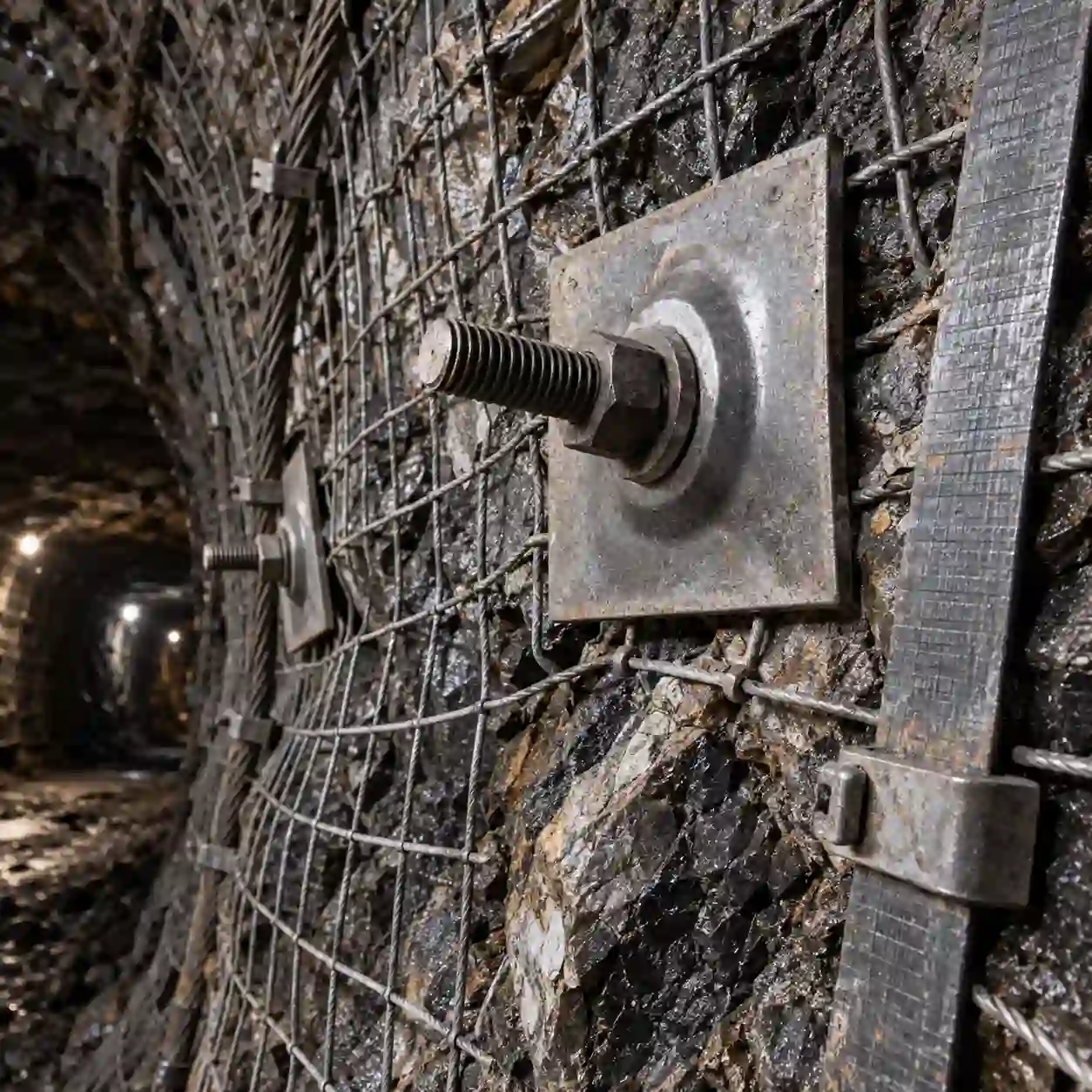
This three-function concept is useful because many products overlap between categories. Rock bolts reinforce and hold. Mesh retains. Plates transfer force between the bolt and the surface-support system. Steel straps connect support points and distribute surface loads. Shotcrete retains AND confines fractured ground.
Engineering ground- support literature makes a similar distinction between rock reinforcement and surface support. Articles discussing ground support in more difficult mining conditions tend to describe reinforcement, retaining AND holding functions as parts of an overall system that work together.
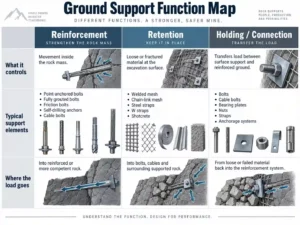
Ground Support Function Map
| Main function | What it controls | Typical support elements | Where the load ultimately goes |
| Reinforcement | Movement and loss of integrity inside the rock mass | Point-anchored bolts, fully grouted bolts, friction bolts, self-drilling anchors, cable bolts | Into reinforced or more competent rock |
| Retention | Loose or fractured material at the excavation surface | Welded mesh, chain-link mesh, steel straps, W straps, shotcrete | Into bolts, cables and surrounding supported rock |
| Holding / Connection | Transfer between surface support and reinforced ground | Bolts, cable bolts, bearing plates, nuts, straps and anchorage systems | From failed/loose material back into the reinforcement system |
Note: These are functions, not mutually exclusive product categories. One product can have multiple functions.
This list also helps clarify why ground support should be specified as a system rather than just buying bolts, plates or mesh separately.
Point-anchored Bolts – Mechanical Expansion-Shell Rock Bolts
Point-anchored bolts send most of their force through an anchorage at or near the rear of the hole.
Mechanical point anchorage uses an expansion shell or similar device. As the bolt is tensioned, the anchor presses against the borehole wall to facilitate load transfer between bolt and rock.
Mechanical point anchorage allows for development of support immediately after proper installation.
Also note that its load transfer capabilities are heavily influenced by the quality of rock around the anchorage.
Unsuitable or weak rock conditions around the expansion shell may indicate another anchoring method would work better.
NIOSH also states: roof-bolt system design cannot be simplified to the selection of a bolt type. The geology and stress conditions present affect how available reinforcement mechanisms work.
Mechanical bolts can also be used with resin or grout in composite engineered systems.
Buyers should know the difference between mechanically anchored, resin-assisted mechanical and fully bonded bolts and bolt systems.
They do not react to load the same way.
Read Wanfeng’s Rock Bolt Types Guide.
Fully Grouted Bolts – Resin and Cement-Grouted Rock Bolts
Fully grouted bolts rely on load transfer along much of their total embedded length, unlike a traditional point-anchor style system.
Chemical resin and cementitious grout are the two anchoring media possible.
Resin provides its load-bearing interface by curing as a bonded contact between reinforcement and borehole.
With cement grout, the grout fills around the bar and hardens to form load-bearing contact around the length of the bar.
Do not assume:
resin systems are only for mining and
cement grout is exclusively used in tunneling applications.
Both resin and cement can be used underground.
Resin may be preferred if early support and fairly rapid setting time is needed.
Cement grout may be chosen for full-bar anchoring, hollow anchors or larger grout volumes.
Wanfeng even categorizes its resin cartridges by gel times and dimensions, not just one standard resin formulation.
Refer to published resin system specifications to see how factors like rock strength, anchorage length and bolt diameter affect performance and capacity more than resin grade alone.
Resin Vs Cement Anchorage Systems
Friction Bolts – Split Set and Swellex Systems
Split set bolts and inflatable bolts use friction between the bolt and borehole wall instead of normal full-bar resin bonding or point-anchor load transfer.
Split Sets and inflatable bolts are friction-type reinforcement, but they are very different systems.
Split Set anchors are made from a slot-drilled steel tube hammered into an undersized hole. Collapsing the tube fits it against the borehole wall over its length. Legend explains the principle as “full contact” friction.
Swellex is made from a collapsed sealed tube expanded with high-pressure water. Once expanded, the thick walled profile holds against the borehole wall by contacting the uneven spots. Epiroc states minimum breaking loads ranging from 120 – 240 kN for various Swellex models.
Splitlets are fast and easy to install like Swellex, but borehole diameter still matters.
If you choose friction-based reinforcement, using too large or too small of a drill bit will change how the bolt works with the rock.
Make sure when specifying a friction bolt you also specify:
bolt diameter + hole diameter range + drill capacities + ground conditions.
If you leave out one, you riskIncomplete Specifications.
Split Sets and Swellex were once trademarks of their original manufacturers. As generic terms in a technical article, it helps to use friction stabilizer or inflatable friction bolt to describe the entire category.
Self-Drilling Anchors – Hollow Anchors
Self-drilling anchors are ideal for conditions where drilling a regular unsupported borehole may fail due to weak ground conditions, caving or heavy ground pressure.
These bolts drill themselves. That is the important part to remember.
Drill Bit → Hollow Threaded Bar → Coupler → Grout Tube → Plate & Nut
Self-drilled anchors combine everything necessary to act as both the drill and the installed reinforcement member.
The bar “self-drills” then a grout passage transfers resin or cement through its hollow centre up to the plate.
Because the anchor bar remains in place during installation there is no need for maintaining a clear hole until after installation.
There are multiple self-drilling anchor systems throughout Wanfeng’s product lists. We carry T40 and T52 hollow self-drilling anchors for mines, tunnels, underground metros and more. The rock mass is either weak or heavily fractured where these systems have been selected.
T40 systems list ultimate loads from 540 – 660 kN. While T52/26 anchors list one ultimate load of 929 kN.
One family is not automatically stronger and able to substitute for the other.
Those anchors serve different purposes and load capacities. Wanfeng’s T76 series list ultimate loads from 1,600 – 1,900 kN. The T103 size goes even higher.
Bolt diameter is just one part of the specification.
Length, grout diameter, ground conditions, thread size, drilling method and corrosion protection on the threads and collar are relevant parts of the complete anchor design.
Rock Bolting & Anchoring Guides
Cable Bolts – Long Anchorages for Far-Reaching Ground Control
Cable bolts anchor farther into the rock than traditional short rock bolts.
Short rock bolts use solid bars. Cable-bolting systems utilise steel strand.
Systems vary, some grout cable bolts. Some tension them after installation. Many cable bolts anchor into plates with mechanical locking devices.
Rock reinforcement must reach farther into the groundmass. Nearby ground must be tied back to prevent failure where you have larger openings or underground excavations that need deeper support.
Take large stopes, wide spans, tunnel excavations and any area requiring deep cable bolt support.
Compare that need to rock that fails along the first few feet near your excavation.
Using longer cable bolts does not suddenly mean you should remove all short bolts.
Support designs use shorter bolts near the excavation to stabilize rock that will break near surface.
Longer cable bolts help prevent major failures by tying into deeper and more stable ground. The deeper rock has to move far more before it causes damage to your excavation.
Epiroc provides the specifications for an 18 mm Anti-Spin Cable as an example. This cable lists 270 kN as a typical tensile load when un-grouted. With mechanical pretension applied after installation, the anti-spin cable lists 25-35 kN as its pretension range.
That is just one specific cable product. There is no universal value for cable bolts.
Wanfeng provides some cable bolt accessories for anchoring longer reinforcement including strand locks for 15.24mm, 17.8mm and 21.8/22mm steel cables.
Don’t think of cable bolts as something you simply install. Along with the strand itself, define the grout or anchoring system. Define the plate, lock and installation process when you specify cablebolt support.
Published Load Figures by Support Type
When comparing supports technically responsibly, one should not say that every resin bolt is rated at “X–Y kN” or that every cable bolt has one set load.
Steel section, bar design, anchor mechanism, embedment, grout, borehole and test method all affect capacity.
The following table therefore gives representative published commercial values, not universal design ranges.
| Support family | Representative published figure | What that number describes | Muhim cheklov |
| Resin-anchored conventional bolt | 170–210 kN | Epiroc HelixBolt typical static capacity, depending on bar diameter | Product-specific, not all resin bolts (Epiroc) |
| Resin-anchored yielding bolt | 224–272 kN | Epiroc PAR1 Resin Bolt typical static capacity | Dynamic/yielding design; cannot be generalized to standard rebar (Epiroc) |
| Point/end-anchored yielding bolt | 224 kN | Epiroc PAR1-K typical static load capacity | Specific 20 mm yielding system (Epiroc) |
| Inflatable friction bolt | 120–240 kN | Swellex published minimum breaking loads | Depends on Swellex model, not Split Set friction stabilizers generally (Epiroc) |
| Self-drilling hollow anchor | 200–925 kN | Published Epiroc SDA/hollow-core ultimate-load examples across several bar sizes | Wide range because bar sizes differ substantially (Epiroc) |
| Wanfeng T40 SDA | 540–660 kN ultimate | T40/20 and T40/16 published values | Manufacturer/model-specific (WF Ground Support) |
| Wanfeng T52 SDA | 929 kN ultimate | T52/26 published value | One bar configuration (WF Ground Support) |
| Cable bolt example | 270 kN tensile | Epiroc 18 mm Anti-Spin Cable, ungrouted | Specific cable construction, not a general cable-bolt limit (Epiroc) |
| Dynamic/yielding bolt | ≈215–272 kN static | Representative Vulcan/PAR1 published static capacities | Dynamic performance must also be evaluated by displacement and energy absorption (Epiroc) |
Why you should use this table
Static load capacity is only one factor when specifying a support system.
In many cases of dynamic or squeezing ground conditions, displacement capacity and energy absorption may be equally important as static peak load. ACG defines load capacity, displacement capacity and energy absorption as three key performance indicators of support in tough ground conditions.
When purchasing, always ask for the certified yield, ultimate, pull-ont/interface and -where applicable- dynamic test data for the specific product being offered.
Surface Support — Mesh, Steel Straps, W Straps and Shotcrete
Rock bolts can’t support every small piece of fractured rock that occurs between bolt locations.
That’s where surface support comes in.
ACG classifies steel mesh, straps and shotcrete as common types of underground surface support. Reinforcement elements penetrate the rock mass and surface support ties those points together while containing fractured material that falls between them.
Mesh
Welded wire mesh and chain-link mesh panels provide coverage over an area of the excavation surface.
Their purpose is not simply to “make the wall stronger”. More accurately, mesh panels retain loose material between reinforcement points and transfer loads to bolts, plates and other support elements.
Steel and W Straps
Steel straps bridge the space between bolts, allowing surface loads to be spread across multiple anchorage points.
Wanfeng produces a range of W steel straps designed for use with rock bolts, roof bolts and bearing plates during mine and tunnel reinforcement. You can see varying widths, thicknesses and hole patterns in the product range we currently publish.
View W Steel Straps for Mining Support
Betonni po'latlash
Shotcrete creates a layer across the entire surface while also providing confinement and retention around uneven rock faces.
ACG includes shotcrete in many of our examples instead of automatically replacing mesh and reinforcement.
The appropriate combination of reinforcing elements depends on the expected deformation, rock fragmentation size and required service life of the support.
Think again about how a support system behaves under load…
Although a bolt may have sufficient capacity, that load must transfer through the plate, mesh or strap into the bolt.
Dynamic / Yielding Support — Accommodating Movement in the Ground
Most people are taught to think about preventing movement.
But deep level mines experience squeezing ground conditions and rockburst-prone environments where it may be impossible to prevent all movement from occurring.
Instead of trying to prevent deformation, yielding support can allow for controlled movement while load carrying capacity is maintained.
The focus of engineering design shifts from:
“How strong is this bolt?”
To:
“How much load can this system support, throughout how much displacement, and how much energy can it absorb?”
ACG’s page on yielding support systems describe them as one of the key advances in modern mining support for this reason.
Manufacturers advertise typical static load capacities as one way to capture attention. Knowing static capacity alone is useless tells part of the story when you can also see specified energy absorption and total elongation.
Epiroc’s Vulcan support range lists typical static capacities of 215–216 kN but also includes ratings for how much energy the system can absorb.
PAR1 resin bolts are another example from the market that provides both load capacities and energy / displacement ratings.
Excavating in dynamic ground? Understanding how much and where the ground may move should influence your support selection.
Systems with very different load capacities and stiffness can perform drastically different when the ground moves.
Pillar to come: this section should link to the Dynamic & Yielding Ground Support Systems pillar page when it’s published.
Selection Framework — Approaching Mining Ground Support Systems
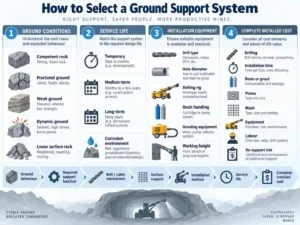
Ground-support should be designed around expected rock mass behaviour, not around what your supplier has available.
Ground Conditions
Rock that is otherwise competent but jointed may require reinforcement across the discontinuities.
Weak or highly fractured ground presents borehole stability issues where fully grouted or self-drilling options might become attractive.
High stress or squeezing conditions require support to accommodate some degree of displacement.
Environments where rockburst are a possibility have entirely different dynamic requirements and energy-absorption capacities.
Loose rock around the surface could warrant mesh or shotcrete in addition to any deeper reinforcement.
The same tunnel or excavation can require a combination of support types because surface retention and deep reinforcement address different challenges.
Required Service Life
Just because something will be used as temporary development support doesn’t mean it should have the same corrosion, coating or durability specification as permanent infrastructure support.
Exposure to groundwater, humidity and chemical processes can affect steel support elements. Bolts installed into shale or saprolite may deteriorate faster than ones installed into sound rock.
Long-life support considerations should review corrosion protections allowed by specification, along with required grout coverage, coating systems and ease of inspection.
Minimize risks during installation by reviewing Wanfeng’s support specification guidance. Their selections treat corrosion resistance and exposure environment as explicit parameters when selecting support.
Installation Equipment and Planned Mine Cycle
The perfect bolt on paper that can’t be installed properly with existing equipment or machinery may become completely unusable operationally.
Will the drillships be twist drills or down-the-hole? Will plug port style friction bolts match up with the available bolting rigs? How will resin cartridges be handled? Is there appropriate grouting equipment? How tall are personnel? Will the support be installed before or after ground exposure?
Friction bolts, resin bolts, cable bolts and self-drilling anchors all have different installation considerations that affect how support will fit into the overall mine cycle.
Keep in mind that mechanization heavily influences consistency and quality control.
Cost — Compare Installed System Costs, Not Bolt Price
Bolt prices do not automatically translate to lowest cost ground-support solution.
Installed costs can include drilling & placement time as well as accessories like grout or resin,plates, mesh, equipment rentals, labour, quality assurance costs and even re-support should ground fail.
More importantly, your support system has to work. Engineering design should establish minimum performance requirements before procurement tries to find the best cost solution for:
Comparable complete systems under similar design criteria, not standalone bolt prices from unrelated manufacturers.
Terminology Variations: US, Australia & Europe
Ground-control terminology hasn’t been standardized globally.
A specification authored in the United States might have alternate preferred terminology to that of an Australian hard-rock mine or UK underground project for components that are essentially the same.
Keep this in mind, this table is a terminology reference, not an engineering standard.
| Concept | United States / North America | Australia | UK / Europe | Procurement note |
| General discipline | Ground control / roof control | Ground support / ground control | Ground control / ground support | Confirm whether discussion covers coal, hard rock or civil tunneling |
| Short rock reinforcement | Roof bolt / rock bolt | Rockbolt | Rockbolt | “Roof bolt” is especially common in US coal-mining literature (CDC Stacks) |
| Long strand reinforcement | Cable bolt | Cable bolt | Cablebolt / cable bolt | UK HSE guidance explicitly distinguishes rockbolts and cablebolts |
| Slotted friction tube | Split Set / friction stabilizer | Split Set / friction bolt | Friction bolt / stabilizer | Split Set is also a proprietary product name |
| Inflatable friction element | Swellex / inflatable bolt | Swellex / inflatable rockbolt | Inflatable rockbolt | Swellex is a specific commercial system, not the generic name for all friction bolts (Epiroc) |
| Surface wire support | Wire mesh / screen | Mesh / weldmesh / chain-link mesh | Mesh / reinforcement mesh | “Screen” occurs more often in some North American usage |
| Linear surface reinforcement | Strap / steel strap | Steel strap / mesh strap / W strap | Steel strap / reinforcement strap | Exact profile must be specified |
| Sprayed concrete support | Betonni po'latlash | Betonni po'latlash | Shotcrete / sprayed concrete | Do not assume mix design or fibre reinforcement from terminology alone |
| Hollow drill-and-grout anchor | Self-drilling anchor / hollow bar | SDA / hollow bar anchor | Self-drilling anchor / hollow bar | Confirm thread, bit, coupler and grout system |
NIOSH publications refer to both “roof bolt” and “rock bolt” in United States mining literature. Australian ground-support documents typically refer to rock reinforcement, mesh, straps as well as ground support. UK HSE issues guidance for rockbolts and cablebolts separately.
Differences in terminology are one reason product names should not be used exclusively in international RFQs; instead drawings and technical specifications should be used.
Assembling the System
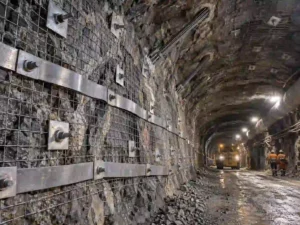
One effective underground roadway support system might include:
- rock bolts to reinforce the rock mass
- resin or grout to provide anchorage
- bearing plates to help transfer surface forces
- mesh to retain small fractured rock
- W straps to connect reinforcement points and help distribute surface loads.
Cable bolts might be added if there is a deeper potential instability zone.
Self-drilling hollow anchors could make sense if there are poor drilling conditions.
Yielding support elements might be required if ground is dynamic or squeezing rather than stable and stiff.
These are not mutually-exclusive products to rank from best to worst.
They address different components of the overall ground-control challenge.
That’s the essence of systematic mine ground-support engineering:
The right question is not “Which bolt is best?” but instead “What combination of reinforcement, retention and load- transfer components will match the expected ground behaviour?”*
Please see Wanfeng’s customized service:Yer usti ta'minoti muhandisligi va OEM xizmatlari
TSS
1. What is ground support in mining?
Mining ground support includes rock bolts, cable bolts, mesh, straps, shotcrete, plates and steel support installed to reinforce rock and control loose or broken material around underground excavations.
2. What is the difference between rock reinforcement and surface support?
Rock reinforcement elements placed into or on the rock mass help modify or control its internal behaviour. Surface-support elements help retain broken rock at the excavation periphery and transfer loads toward reinforcement elements.
3. What are the main types of rock bolts?
Categories of rock bolts include mechanical point anchors, resin or cement-grouted bolts, friction stabilizers, inflatable bolts and self-drilling hollow anchors. There are also yielding rock bolts used to accommodate large deformations. Keep in mind the categories can overlap depending on how they achieve anchorage and load transfer.
4. What is the difference between a Split Set and Swellex bolt?
Both Split Sets and Swellex bolts are types of friction stabilizers that require contact with the borehole wall to generate support capacity. A Split Set-type friction stabilizer is driven into an undersized hole creating radial frictional pressure. A Swellex bolt is inserted as a folded steel tube and then expanded using high-pressure water after installation. The main difference is how the load transfer component is installed.
5. When are cable bolts used instead of rock bolts?
Mining cable bolts are used where higher-capacity reinforcement is needed deeper into the rock mass. They are seldom used as a simple replacement for rock bolts and are often installed in combination with them to improve load distribution across a large potential instability area.
6. What does wire mesh do in underground mines?
Mesh is metal fabric installed to retain fractured rock between reinforcement locations. It helps distribute applied loads toward bolts, plates and other support elements. Mesh is not deep reinforcement. It cannot prevent deformation of the rock mass.
7. What is a W strap used for?
A W strap is placed perpendicular to rock bolts to connect reinforcement locations and help distribute surface loads over a larger area. While occasionally used alone in compliant support applications, it is normally used in conjunction with other surface-support elements.
8. Is the bolt with the highest load rating always best?
No. Although installation strength is important, many other factors affect support selection. Ground support has to be compatible with expected displacement demands, durability requirements, installation quality, corrosion conditions and desired service life.
9. What ground support is best for dynamic or rockburst conditions?
Ground that has the potential for sudden energy release during dynamic events generally requires special support designed to accommodate both load demands and deformation energy. Yielding rock bolts and dynamic surface-support elements can be part of the solution, but rock mechanics and geotechnical engineering are necessary to design the complete support system.
10. Can multiple ground-support systems be used in one mine?
Absolutely. One mine will often have multiple rock types, stress environments, excavation geometries and service conditions. Ground-support systems commonly change based on geotechnical domain or excavation type within the same mine.
Summary: Consider Complete Systems First
Assembling components into a complete ground-support system that fits the anticipated ground behaviour will always outperform optimizing individual products.
There’s no magic bullet for ground support.
Point anchors are one of many tools for providing anchorage where it is needed.
Fully-grouted bolts are effective for distributed load transfer.
Friction bolts offer rapid reinforcement with borehole contact.
Self-drilling anchors reduce installation problems in poor ground conditions.
Cable bolts may be needed to extend reinforcement deeper into the rock mass.
Mesh and straps help control the excavation perimeter.
Shotcrete can help with surface-control requirements.
Yielding components help when the ground itself must be allowed to deform while support retains load-bearing capacity.
With so many different functions to consider, it makes sense to start designing ground support by thinking of expected:
Ground Behaviour → Support Function Needed → Bolt/Cable Mechanism → Surface Support Needed → Installation Method → Service Life Required → Total Installed Cost.
Starting with the manufacturer’s product catalogue will rarely lead to the best solution.
 Tegishli






Har doim ajoyib xizmat